
When Republicans talk about Medicare waste, they rarely mention the corporations and systemic inefficiencies that cos billions.
Medicare was signed into Law on July 30, 1965, by President Lyndon Johnson. It was a moment of important change. The program was established to address the lack of adequate protection for the elderly against the high cost of healthcare, a significant gap in the social insurance system at the time. Before this, there was no real safety network for elderly Americans to afford healthcare. This led to financial hardships. In 1972, Medicare was expanded to help cover those with end-stage renal disease and for younger adults who were disabled.
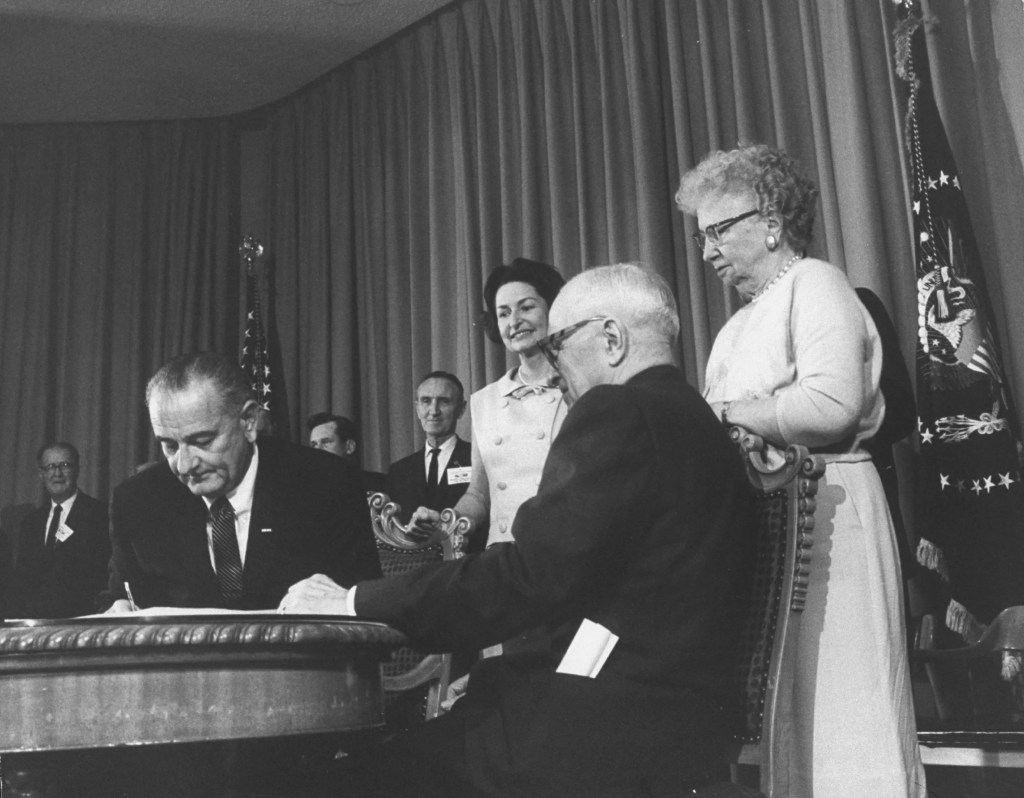
Above, President Lyndon Johnson signed Medicare into law. Former President. Harry Truman and First Lady Bess Truman received the first Medicaid cards.
Medicare has since been expanded to include the following.
1. Medicare Part C (Medicare Advantage):
- Introduced in 1997, Part C allows beneficiaries to choose private health insurance plans, such as HMOs and PPOs, to receive their Medicare benefits.
- This expansion aimed to offer more choices and potentially lower costs for beneficiaries.
2. Medicare Part D (Prescription Drug Coverage):
- Created in 2003, Part D provides prescription drug coverage to all Medicare beneficiaries.
- This addressed the rising costs of prescription drugs and the need for affordable access.
3. Preventative Services:
- The Affordable Care Act (ACA) in 2010 expanded Medicare coverage for preventative services, such as mammograms, diabetes screenings, and flu shots.
- This aims to improve health outcomes and reduce long-term healthcare costs by focusing on early detection and prevention.
4. Other expansions and modifications:
Eligibility rules and payment systems have also been modified to control costs and improve the efficiency of the program
Over the years, Medicare has also expanded to cover other services, such as hospice care, mental health services, and home health benefits.
The expansions were intended to improve access, efficiency, and affordability; they would also inadvertently open the door to new vulnerabilities. The situation would get worse as more private entities became involved. Over time, the Medicare program has grown in size, complexity, and cost. But when political leaders talk about “waste,” they often shift blame toward patients or low-income recipients rather than confronting the actual drivers of inefficiency.
So where is the real waste?
Despite what Republican talking points may say, the true source of Medicare waste doesn’t come from patients abusing the system. They came from fraud, inefficiency, and private sector exploitation. Here is what is actually going on:
1. Fraud and Waste:
Every year, Medicare loses $60 to $100 billion to fraud — and it’s not from individuals. It’s providers billing for services not rendered, falsifying diagnoses, or overcharging for treatments.
- Common schemes: phantom billing, kickbacks, identity theft
- Real example: Clinics billing Medicare for physical therapy sessions that never happened
Source: National Health Care Anti-Fraud Association
2. Improper Payments: Bureaucratic Misfires
In fiscal year 2023, Medicare made $31.5 billion in improper payments, per the GAO. That includes overpayments, underpayments, or payments made without proper documentation — not intentional fraud, but bureaucratic sloppiness.
Source: GAO Report on Federal Improper Payments
3. Overutilization: When Too Much Care Becomes Waste
Studies show up to 30% of U.S. healthcare spending is wasted — and that includes unnecessary tests, scans, and procedures. Providers may do this to avoid lawsuits (defensive medicine) or simply to boost billing.
Source: National Academy of Medicine – Best Care at Lower Cost (2013)
4. Medicare Advantage: Private Profits at Public Expense
Medicare Advantage (Part C) — meant to offer “choice” — has become one of the biggest contributors to Medicare waste. Private insurers overbill the government by exaggerating how sick patients are through a practice called “upcoding.”
- They also often deny necessary care more frequently than traditional Medicare.
- Tens of billions are wasted while corporate profits soar.
Sources:
5. Administrative Waste: A Byproduct of Complexity
The U.S. healthcare system wastes $265 billion annually on administration alone. Medicare contributes to this through:
- Redundant billing codes
- Complex documentation rules
- Payment processing inefficiencies
Source: JAMA – Waste in the US Health Care System (2019)
When you hear Republicans lecture about “Medicare waste,” ask yourself: Are you blaming patients, or the corporations profiting from inefficiency and fraud? If we are serious about saving Medicare, we need to stop gaslighting and punishing the poor and start holding the real wasters accountable.





 Throughtful Reader
Leave a comment