
With the headaches of President Trump’s tariffs being passed, I decided to go dumpster-diving to see how history has treated tariffs. We are familiar with the McKinley Tariff Act of 1890 and the Hawley-Smoot Tariff Act of 1930. However, I have found some interesting tariffs that have been implemented in the past. This one stood out to me particularly. I had no idea that Harley-Davidson needed to be saved in the 1980s from competition in Japan. Let’s get started. Enjoy reading.
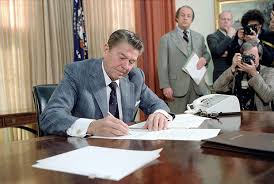
The 1983 motorcycle tariff, or Memorandum on Heavyweight Motorcycle Imports, was a presidential memorandum ordering a 45% tariff on heavyweight motorcycles imported to the United States, signed by President Ronald Reagan on April 1, 1983, on the US International Trade Commission’s (USITC) recommendation to approve Harley-Davidson’s petition for import relief. The tariff expired in 1988
Harley-Davidson was the sole surviving American motorcycle manufacturer. All of the company’s models in production were heavyweight motorcycles. Before the imposition of the tariff, Harley-Davidson faced a sharp decline in sales, primarily due to competition from Japanese motorcycle companies. Less than a decade prior, Harley-Davidson had a 100% market share of motorcycles with an engine size of 1000cc or more prominent within the US. Its market share fell to less than 15% a decade later. Honda, Yamaha, Suzuki, and Kawasaki undercut Harley-Davidson by $1,500 to $2,000 per vehicle. In 1980, Harley-Davidson generated $289 million in sales, but by 1982, sales had declined to around $200 million. Employees also saw a harsh decline in wages and hours worked. The unsold inventory of bikes doubled during the period, again due to the undercutting of Japanese counterparts.
In the early 1980s, Harley-Davidson petitioned the USITC, claiming that Japanese manufacturers were importing motorcycles into the US in such large quantities as to harm or threaten to harm domestic producers. The USITC agreed (by a 2–1 vote) that Harley-Davidson was entitled to relief and recommended the tariff structure that the Reagan Administration later implemented. Unlike the USITC’s recommendation, Reagan also implemented tariffs on European manufacturers. The tariff applied to all imported motorcycles with engine displacements exceeding 700 cc. Reagan signed a memorandum ordering the tariff on April 1, 1983, and signed Presidential Proclamation 5050 on April 15, enacting it into law as 97 Stat. 1574 to the United States Code
During the first year of the tariff, the rate was set at 45%, then dropped to 35% in the second year. In the third year, the tariff was reduced to 20%, 15% in the fourth year, and 10% in the fifth year. The total tariffs on foreign motorcycles were 49.4%, 39.4%, 24.4%, 19.4%, and 14.4% each year. To avoid harming small-scale manufacturers, tariff-rate quotas were implemented. These quotas exempted manufacturers from the additional tariffs implemented by the bill. Still, they required them to pay the 4.5% rate on all motorcycles as part of a tariff that remains in effect today. Five thousand units (increasing yearly to 6,000, 7,000, 8,500, and 10,000) of motorcycles were tariff-exempt for motorcycles manufactured in the Federal Republic of Germany. This tariff applied almost exclusively to BMW motorbikes. Six thousand units (increasing by 1,000 yearly) were exempt for motorcycles imported from Japan. Four thousand units (increasing yearly by 1,000) were tariff-exempt for all other countries. This tariff did not apply to any bikes manufactured within the country, which exempted the 90,000 Honda and Kawasaki bikes manufactured in the US.
Harley-Davidson subsequently rejected offers of assistance from Japanese motorcycle makers. The legislation was also met with significant resistance from Japanese authorities, who threatened to file unfair trade charges against the United States in Geneva. Motorcycle prices were not projected to rise until the backlog of motorcycles had been sold. They were then projected to increase by 10%.
Harley-Davidson did offer to drop the request for the tariff in exchange for loan guarantees from the Japanese.
In March 1987, Harley-Davidson took an unprecedented action and requested the removal of the tariff. “We no longer need tariff relief to compete,” said Vaughn L. Beals Jr., Harley-Davidson’s chairman and CEO. Ronald Reagan removed the tariff on October 9, 1987, claiming that the action would not harm the domestic industry.
References
About: 1983 motorcycle tariff. https://dbpedia.org/page/1983_motorcycle_tariff
Memorandum on Heavyweight Motorcycle Imports | The American Presidency Project. https://www.presidency.ucsb.edu/documents/memorandum-heavyweight-motorcycle-imports
https://www.revzilla.com/common-tread/motorcycle-tariffs-and-harley-davidson
https://web.archive.org/web/20080308143411/http://www.japanlaw.info/lawletter/july83/ase.htm
https://www.reaganlibrary.gov/archives/speech/memorandum-heavyweight-motorcycle-imports



 Throughtful Reader
Leave a comment