
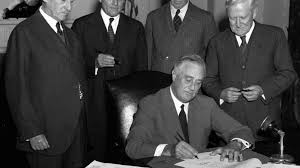
To understand their goals, we need to understand the times that they were being applied to. During the 30’s there was the Great Depression. A time economic loss, and massive unemployment. The Government needed to act to stabilize the losses and attempt to rebuild the economic infrastructure. The Great Society of the 60s was a different time. There was economic growth and expansion during this time. In this essay I will explain what those programs were, how they are similar, but also how they were different.
The Great Depression was one of the biggest economic crashes in the US’s history. The New Deal presented by FDR was an effort to focus on economic recovery and relief. (Foner) It was a broad range of policies in the 1930s. One of the first goals was to address the banking crisis that was left from Hoover’s administration. Congress would pass the “Emergency Banking Act” in March of 1933. (Foner) It provided federal funds to help shore up the threatened institutions. Following that was the “Glass-Steagall Act” which would bar commercial banks from becoming involved in buying and selling of stocks. (Foner) The law would prevent many of the poor practices that contributed to the Stock Market crash of 1929. The Law would help establish the “Federal Deposit Insurance Corporation (FDIC)”. (Foner) The program would insure the accounts of individual depositors. (Foner)
Roosevelt would continue with the passing of the “National industrial Recovery Act”. It established a system of self-regulatory through the “National Recovery Administration”. The program lasted until 1936 when it was overturned as unconstitutional by the Supreme Court. (Foner) The NRA mentioned helped establish codes of standards for production, prices, and wages in the steel, mining, and auto industries. (Foner) To help get Americans back to work, the administration with the help established the “Civilian Conservation Corps”. (Foner) This would set young men to work on the projects like Forest preservation, flood control, and the improvement of the national parks. It also came to an end in 1942, but not before 3 million people passed through the camps and received government wages. Public Works Administration was a pivotal program as well. This program put people to work on items, such as roads, schools, hospitals, and other public facilities like the Robert F Kennedy Bridge in NYC. (Foner)The “Tennessee Valley Authority” would help put Americans back to work. This was established to help with he is building of a series of Damns to prevent floods and deforestation along the Tennessee river. (Foner) Housing would become a big issue during this time. To combat homelessness, the administration established the “Federal Housing Administration”. (Foner) This would insure millions of long-term mortgages issued by private banks. The Federal Government itself would build thousands of housing units for low rentals. (Foner)
As the 30s went on, the administration would have to find other ways to address the unemployment issues the country was still going through, Before the Rural Electrification Agency was passed, 80% of the farms and homes in the rural areas were still without electricity. The program was designed to address this, and by the 1950 90% of the nation’s farms had been wired for electricity. (Foner) One final thing the administration signed into law was the historic passing of the “Social Security Act” of 1935. (Foner) Roosevelt felt the Government had a responsibility to the “Material well-being of Ordinary Americans”. (Foner) It would create a system of unemployment insurance, old age pensions, and aid to people who had disabilities, the elderly poor, and families with dependent Children. While not all were entirely successful, Roosevelt’s target was to address poverty and unemployment. Pres. Lyndon Johnson’s, while like FDR in many ways, addressed it quite differently.
Unlike the New Deal which dealt with the depression. The Great society was a response to “prosperity”. (Foner) The 1960s went through a time of rapid economic expansion. An expansion that was fueled by increased government spending, and tax cuts for individuals and businesses. Pres. Johnson believed that economic growth would make it possible to fund new ambitious programs and to improve the “Quality of Life”. (Foner)
With his landslide victory in 1964 over Barry Goldwater, Pres. Johnson presented an huge proposal for government actions to improve general welfare. (Foner) Between 1965-67 the Johnson Administration passed a wide scope of programs to benefit as many Americans as it could, it would be known as the “The Great Society”, (Foner) The Congress would work with the administration in passing pieces of legislature, such as Medicare, Medicaid, urban development, and Education. (Foner) Two Cabinet positions would also be created to help oversee some of the new programs that were passed. They were the Department of Transportation, and “Housing and Urban development”. (Foner)
The signing of Medicare was very significant. It would cover “hospital and physician costs for the elderly who qualified”, and Medicaid would cover healthcare costs for people getting cash assistance from the government. (HC) This would provide a big safety net for those who were most vulnerable.
Education was very important and in 1965, the “Elementary and Secondary Education Act” was passed. (HC) This would allow guarantee that federal funds reach the school districts whose student majority were low income. (HC) The program would cover these following items, such as funded preschool programs, supported school libraries, supported school libraries, provided special education services. (HC)
Pollution was also addressed during this time. In 1965 the “Water Quality Act” was passed to establish a national quality of standards for water. (HC) Also, the first Vehicle emission standards were passed when the Johnson signed the “Motor Vehicle Air Pollution Control Act”. (HC)
Finally, the national quota for immigration was eliminated when the Pres. signed the “Immigration and Nationalization Act”. (HC) This would focus on reuniting families, but still put limits on “Immigrants per country”, and “total Immigrants”. (HC)
Johnson would also sign the “Housing and Urban Development Act” of 1965. The Act would create the cabinet position I mentioned earlier, and provided federal funds to cities who met the minimum housing standards. (HC) It would also provide easier access to mortgages and rent subsidy programs that would help lower income Americans to qualify for “Public housing”. (HC)
While both programs were to help the poor, their methods and situations were very different. Johnson’s policy was inspired by FDR’, and it was one of the biggest expansive efforts in the country’s history to address the least-advantaged Americans, especially those of color who were excluded from the New Deal polices like Social Security. (Foner)
(Woods) The New Deal and The Great Society: How They Were Different | TIME
(Foner) Foner, Eric, et al. Give Me Liberty. 7th ed., vol. 2, W. W. Norton and Company, 2022



 Throughtful Reader
Leave a comment